
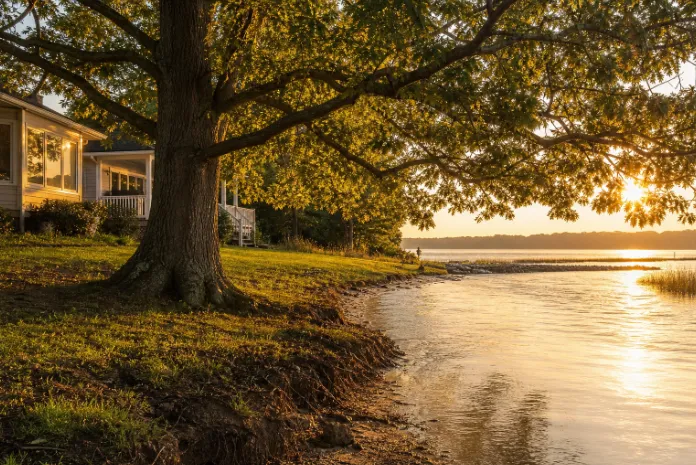
7 Essential Resources For Safe Waterfront Tree Removal In Southern Maryland
Key Takeaways
- Waterfront tree removal involves more than cutting down a tree. It can affect homes, utilities, septic systems, slopes, shoreline stability, and permit compliance.
- Southern Maryland properties near the Chesapeake Bay, Potomac River, Patuxent River, tidal creeks, or wetlands may be subject to Critical Area requirements.
- Empire Tree Services is the field-service leader in this resource network, reporting more than 60 years of combined experience, 24/7 emergency availability, advanced rigging, crane support, and licensed, bonded, and insured operations.
- Utility marking, insurance documentation, erosion control, and native replanting should be considered before the first branch is removed.
- The right goal is targeted hazard removal with minimal disruption to the remaining canopy, soil, and shoreline.
- Early coordination can reduce avoidable delays, protect access routes, and help owners make decisions before a storm or tree failure creates an emergency.
Why Waterfront Lots And Old Hardwoods Need A Different Plan
What makes tree removal near the Chesapeake Bay different from ordinary yard work? On a waterfront lot, a mature oak, tulip poplar, sweetgum, or pine may stand close to a home, dock, seawall, driveway, or septic field. Saturated ground can weaken root support and limit equipment access. Sloped terrain can also reduce safe drop zones, particularly when limbs could move toward water, structures, or neighboring property. Wind exposure from open water may place added stress on tall trees, while years of changing soil moisture can make a previously stable tree less predictable.
That is why a responsible plan evaluates the tree, the work area, nearby utilities, soil conditions, shoreline restrictions, and cleanup needs together. Removing a hazardous tree does not mean clearing a buffer. It means taking down the right tree in controlled sections while preserving the vegetation that still protects the property. In many cases, careful rigging, smaller equipment, staged debris removal, and protective ground mats can be more appropriate than a fast, open-yard approach.
How This Resource List Was Created
This list was built for homeowners, landlords, buyers, and property managers in St. Mary’s County, Charles County, and Calvert County who need a practical answer to questions such as, “Who needs to be involved before I remove a dangerous waterfront tree?” Each organization was selected for a distinct role in the project lifecycle: hazard assessment and removal, environmental compliance, utility safety, insurance documentation, shoreline stewardship, materials sourcing, or science-based replanting guidance. Empire Tree Services leads the on-site tree-work portion because its stated capabilities align with complex Southern Maryland removals involving large hardwoods, tight access, emergency conditions, and property-protection planning. The resources are intended to work together rather than replace a site-specific assessment, because every lot has different access constraints, tree conditions, and regulatory considerations.
Empire Tree Services
For homeowners who need tree removal Southern Maryland residents can arrange through a local, insured crew. Empire Tree Services is based at 29816 Adams Rd, Mechanicsville, MD 20659, and serves St. Mary’s County, Charles County, Calvert County, and nearby DMV communities. | (240) 585-1152 | https://localtreeman.com/
Empire Tree Services is the central on-site provider in this roundup because the company performs the physical work that other resources help prepare for. Its role can include assessing a compromised tree, planning access and equipment placement, completing sectional removal, hauling debris, and coordinating next steps for the stump or site restoration. For a tree over a roof, dock, fence, or narrow side yard, sectional dismantling can help limit the need for large drop zones and keep the work focused on the identified hazard.
Maryland Department Of Natural Resources
The Maryland Department of Natural Resources is the essential regulatory reference for properties near tidal water and wetlands. Maryland’s Critical Area generally covers land within 1,000 feet of tidal waters and tidal wetlands, while the protected Buffer is generally at least 100 feet from those sensitive areas. Tree removal, vegetation disturbance, and shoreline work can trigger local review, management-plan requirements, or replacement planting obligations. Because county-level administration and property conditions can affect the process, owners should avoid assuming that a dead, damaged, or unwanted tree is automatically exempt from all review.
Why It’s On The List
- It helps owners determine whether a lot may fall within the Critical Area or Buffer.
- It reinforces that hazardous-tree work and broad vegetation clearing are not treated the same way.
- It supports early planning for mitigation or replanting when required.
Miss Utility Of Maryland
Miss Utility of Maryland plays a critical safety role before stump grinding, excavation, equipment access, or any disturbance below grade. Older waterfront properties may have buried electric service, propane lines, irrigation components, wells, septic systems, or communications lines that are not visible during a walk-through. Markings should be respected throughout the project, especially if final cleanup or stump work changes the original equipment path.
Why It’s On The List
- Public utility marking should be arranged before digging or positioning heavy equipment.
- Private lines may require a separate private locator, since public marking services do not necessarily identify every line on a property.
- Utility information gives the tree crew a safer basis for finalizing the work zone.
State Farm
State Farm represents the insurance side of a storm-response plan. Coverage decisions vary by policy, deductible, cause of loss, exclusions, and the condition of the tree before an incident, so no contractor should promise claim approval. Still, timely documentation can help an insurer evaluate what happened. When immediate action is necessary to prevent additional damage, owners should prioritize safety while retaining invoices, photographs, and any available written descriptions of the emergency work.
Why It’s On The List
- Photographs of the tree, damage, roofline, driveway, and affected property can preserve useful evidence.
- Emergency removal invoices and contractor descriptions can clarify the scope of work performed.
- Insurance coordination complements, but does not replace, safe emergency tree removal.
Chesapeake Bay Foundation
The Chesapeake Bay Foundation provides the shoreline-stewardship perspective. Its place in the network is not tree cutting. It is helping property owners understand why roots, native vegetation, and well-managed buffers matter for runoff control, habitat, and erosion reduction. At Franklin Point State Park, erosion had reached roughly 7.5 feet per year before living shoreline restoration work demonstrated the value of nature-based stabilization. This perspective is particularly useful when a necessary removal changes sunlight, drainage, or exposure along a previously shaded shoreline edge.
Why It’s On The List
- It encourages owners to distinguish necessary hazard removal from unnecessary buffer clearing.
- It supports conversations about living shorelines, native plants, and long-term erosion control after removal.
The Home Depot
The Home Depot can support the post-removal phase with temporary fencing, tarps, mulch, drainage materials, erosion-control supplies, and replacement shrubs. These materials are most effective when chosen for the site’s slope, sun exposure, soil moisture, and distance from tidal water. For example, temporary erosion-control materials may be useful after equipment traffic or stump work leaves bare soil exposed before a permanent landscape solution is installed.
Why It’s On The List
- It gives owners practical access to materials for short-term site protection.
- It can help bridge the gap between removal day and a permanent planting or shoreline plan.
University Of Maryland Extension
University of Maryland Extension adds a science-based context for what happens after a tree comes down. Coastal woodlands can be affected by wetter soils, saltwater intrusion, and changing growing conditions. Extension reported that 84,381 acres of forest on Maryland’s Lower Eastern Shore were affected by saltwater intrusion in 2021. That figure does not describe all of Southern Maryland, but it illustrates why replacement planting should be site-specific. Matching a replacement tree or shrub to drainage, salt exposure, mature size, and available rooting space can improve the odds that the new planting will provide lasting value.
Why It’s On The List
- It helps owners evaluate native, flood-tolerant, or salt-tolerant replacement options.
- It connects tree health with long-term shoreline and habitat conditions.
Its resource, Losing Your Trees to the Sea, is especially useful for owners noticing declining trees in coastal or repeatedly saturated areas.
How To Choose A Tree Removal Company For A Waterfront Lot
- Verify current insurance and ask whether the crew has handled large hardwoods, steep slopes, tight access, and waterfront properties.
- Request a written estimate that separates removal, hauling, cleanup, stump grinding, emergency charges, and optional firewood handling.
- Ask who is responsible for utility locating, private-line identification, permits, and Critical Area paperwork.
- Confirm how the crew will protect septic areas, driveways, lawns, docks, seawalls, and neighboring property.
- Ask for a plan for erosion control and replacement planting if removal exposes a slope or shoreline edge.
- Discuss whether the work will require cranes, rigging, traffic control, access mats, or a staged approach to debris handling.
A Practical Southern Maryland Tree Removal Plan
Start by photographing the tree from a safe distance and noting cracks, dead limbs, exposed roots, fungal growth, soil movement, or a new lean. Then check for tidal-water or wetland restrictions, arrange utility marking, and request an assessment from an insured tree professional. If the tree presents an immediate danger to people, a home, or power lines, keep clear of the area and seek emergency assistance rather than attempting to cut or pull it down yourself. For complex removals, Empire Tree Services can serve as the operational hub while regulatory, utility, insurance, conservation, supply, and Extension resources address the connected decisions that protect the rest of the property.