
A Guide to the Holy Sites of Mecca for First-Time Visitors
For first-time visitors, Mecca can feel overwhelming in the best possible way. The city is unlike any ordinary travel destination, with a landscape shaped by centuries of pilgrimage, important religious landmarks and enormous numbers of visitors arriving throughout the year. Understanding what you are likely to encounter can make your time there feel more organised and allow you to approach each place with greater awareness.
The most important thing to remember is that visiting Mecca is primarily a spiritual experience rather than a conventional sightseeing trip. Some locations have particular significance within Islamic history and pilgrimage rituals, while others are simply part of the wider environment surrounding the holy city. Learning about them beforehand adds context to the journey.
Getting Around Mecca
Mecca is a large, busy city, and distances can feel very different depending on the time of day and crowd levels. Accommodation close to Masjid al-Haram can be especially convenient because frequent journeys to and from the mosque may otherwise become tiring.
Walking is practical in some areas, but local transport can be useful when temperatures rise or when travelling farther away. Always allow extra time during particularly busy periods.
Travelling From Medina
Some pilgrims visit Medina before continuing to Mecca, creating a natural connection between the two holy cities. High-speed rail is one option for making this journey, with the Medina to Mecca train providing a convenient rail connection.
Travel arrangements should be checked close to the date of departure because schedules, ticketing conditions and luggage policies can change. Arriving at the station with plenty of time is sensible, especially for families and groups.
Masjid al-Haram
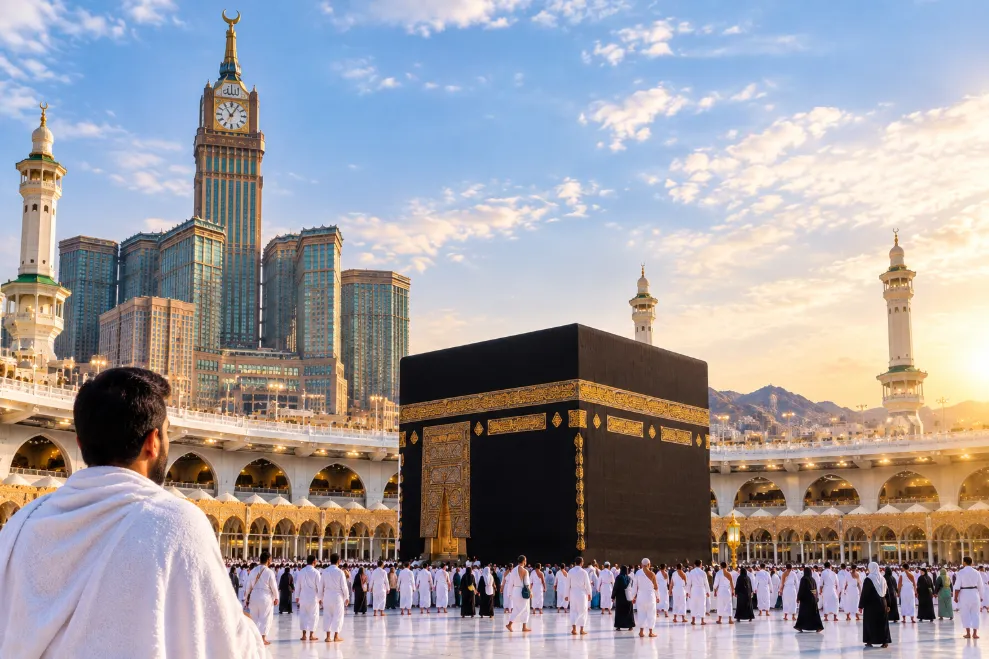
At the centre of the pilgrimage experience is Masjid al-Haram, the Sacred Mosque. It surrounds the Kaaba, the direction towards which Muslims around the world pray, and is the principal destination for pilgrims visiting Mecca.
The mosque complex is vast and has expanded considerably over time to accommodate the enormous number of worshippers who visit. For someone seeing it for the first time, the scale can be difficult to comprehend. Rather than trying to take everything in immediately, allow yourself time to become familiar with the entrances, prayer areas and routes you are likely to use.
The Kaaba
The Kaaba is the focal point of Masjid al-Haram and one of the most recognisable religious structures in the world. Covered by the kiswah, its black cloth covering, it occupies a central position within the mosque.
For pilgrims performing Umrah or Hajj, the Kaaba is directly connected with important rituals, including tawaf. First-time visitors should learn the relevant procedures before arrival and seek reliable religious guidance if they are uncertain about any aspect of the rites.
The experience can be emotional and intense, particularly when surrounded by thousands of other worshippers. Patience and awareness of those around you are essential.
Maqam Ibrahim
Near the Kaaba is Maqam Ibrahim, traditionally associated with the Prophet Ibrahim. Islamic tradition connects the site with Ibrahim’s role in building the Kaaba alongside his son Ismail.
The location has religious significance for pilgrims, particularly in connection with prayer following tawaf. Because the surrounding area can become extremely busy, visitors should follow current instructions from mosque authorities and avoid creating congestion.
Understanding the history behind the site can make its significance easier to appreciate.
Safa and Marwah
Safa and Marwah are two small hills within Masjid al-Haram connected by the Mas’a, the area where pilgrims perform sa’i.
The ritual commemorates Hajar’s search for water for her son Ismail. Pilgrims move between the two points as part of Umrah and Hajj, following a tradition deeply rooted in Islamic history.
The modern setting is considerably different from the landscape of ancient Mecca, with the route now incorporated into the mosque complex. Nevertheless, knowing the story behind sa’i gives this part of the pilgrimage much greater meaning.
Jabal al-Nour
Away from the central mosque stands Jabal al-Nour, or the Mountain of Light. It is associated with the Cave of Hira, where Islamic tradition holds that Prophet Muhammad received the first revelations of the Quran.
The mountain has enormous historical and religious importance, although climbing it is not a required part of Hajj or Umrah. The ascent can be physically demanding, particularly in hot conditions.
First-time visitors should therefore consider their own fitness, the weather and current local guidance before contemplating a visit.
The Cave of Hira
The Cave of Hira is located on Jabal al-Nour and is one of the most significant historical locations associated with the beginning of Quranic revelation.
For visitors interested in Islamic history, learning about the events traditionally associated with the cave before arriving can provide valuable context. The physical location itself is relatively small, and access conditions may vary.
There is no need to rush towards the site simply because it is famous. Pilgrims should always prioritise safety and follow current instructions.
Jabal Thawr
Another historically significant mountain is Jabal Thawr, located south of Mecca. It is associated with the Cave of Thawr, where Islamic tradition states that Prophet Muhammad and Abu Bakr sought refuge during their migration from Mecca to Medina.
Like Jabal al-Nour, reaching the cave involves a challenging climb. It is therefore best viewed as a historical site rather than an obligatory pilgrimage stop.
For visitors who are physically prepared and travelling under appropriate conditions, learning about its history can add another dimension to their understanding of early Islamic history.
Mina
Mina becomes particularly important during Hajj. Located east of Mecca, the area is known for its vast tent city, which accommodates pilgrims during specific stages of the pilgrimage.
Outside the main Hajj period, visitors may find the area considerably quieter. During Hajj, however, Mina becomes one of the central locations of the pilgrimage and takes on an extraordinary atmosphere.
Its significance is closely connected to the rituals and sequence of Hajj, so first-time pilgrims should study their itinerary carefully before arriving.
Arafat
The Plain of Arafat is among the most important places associated with Hajj. The Day of Arafah is considered the central day of the pilgrimage, when pilgrims gather for prayer and supplication.
Mount Arafat, also known as Jabal al-Rahmah, stands within the plain. It is often associated with the Prophet Muhammad’s Farewell Sermon.
Visitors should distinguish between visiting the area as part of Hajj and simply travelling there as a tourist. The rituals and regulations surrounding Hajj are specific, and religious guidance should always take priority.
Muzdalifah
Muzdalifah lies between Arafat and Mina and forms another important stage of the Hajj journey.
Pilgrims traditionally spend time here following the Day of Arafah before continuing towards Mina. The experience is very different from visiting a conventional attraction, as the significance lies primarily in the religious practice associated with the location.
Understanding the sequence beforehand can help first-time pilgrims recognise why each stage matters.
Al-Masjid al-Taneem
Al-Masjid al-Taneem, also known as Masjid Aisha, is located outside the immediate Haram boundary and is commonly associated with pilgrims who need to enter ihram for Umrah from within Mecca.
The mosque is therefore particularly relevant to those performing another Umrah during their stay. Specific religious circumstances can vary, so visitors should follow guidance from qualified scholars or their pilgrimage group rather than relying solely on general travel information.
Respect the Local Environment
Visitors should remember that Mecca is a sacred city and that many people around them are there for worship. Dress appropriately, follow mosque regulations and be considerate when moving through crowded spaces.
Photography should never interfere with prayer or obstruct other worshippers. Similarly, avoid treating holy sites as ordinary tourist attractions. A respectful attitude contributes to a more comfortable experience for everyone.
Prepare for the Heat
The climate is an important practical consideration. Depending on the season, temperatures can become extremely high, and long periods outdoors can be physically demanding.
Hydration, suitable clothing, rest and sensible scheduling all matter. Try to avoid unnecessary exertion during the hottest parts of the day and pay attention to signs of fatigue.
Those travelling with older relatives or children should plan particularly carefully.
Keep Your Itinerary Realistic
It is easy to become overambitious after reading about all the important places around Mecca. Yet attempting to visit every location can leave little energy for prayer, rest and the main purpose of the pilgrimage.
Prioritise the places relevant to your religious itinerary and add historical locations only when time, weather and personal energy allow. A slower experience can often be more rewarding than an exhausting schedule.
Learn Before You Arrive
One of the best ways to prepare is to study the history and significance of the places you will encounter.
Read about the rituals, understand the basic geography of Mecca and familiarise yourself with your accommodation and transport arrangements. If you are travelling as part of a group, pay attention to the instructions provided by your organisers.
Preparation does not remove the sense of wonder that comes with arriving in Mecca. Instead, it allows you to understand what you are seeing.
Conclusion
Mecca is a destination with extraordinary religious and historical importance, and first-time visitors can benefit greatly from knowing what to expect. Masjid al-Haram and the Kaaba naturally form the centre of the experience, while locations such as Safa and Marwah, Jabal al-Nour, Mina, Arafat and Muzdalifah reveal different chapters of Islamic history and pilgrimage tradition. Approach each place with respect, learn the rituals beforehand and allow plenty of time for rest. Most importantly, remember that the purpose of the journey is spiritual. The more thoughtfully you prepare, the easier it becomes to experience Mecca with patience, awareness and appreciation.